Brokerage Journal Sync
Turning raw brokerage fills into a matched, priced journal without manual entry
Overview
A broker reports individual fills, but a journal needs closed positions: entry, exit, fees, result, and holding period on a single row. Reconstructing that by hand means reconciling opens against closes across hundreds of records, which is why most journals are abandoned within weeks. This pipeline does the reconciliation on a schedule instead, pulling the report, parsing it, matching lots, and writing a normalized log that stays correct through partial closes and repeated runs.
Approach & Architecture
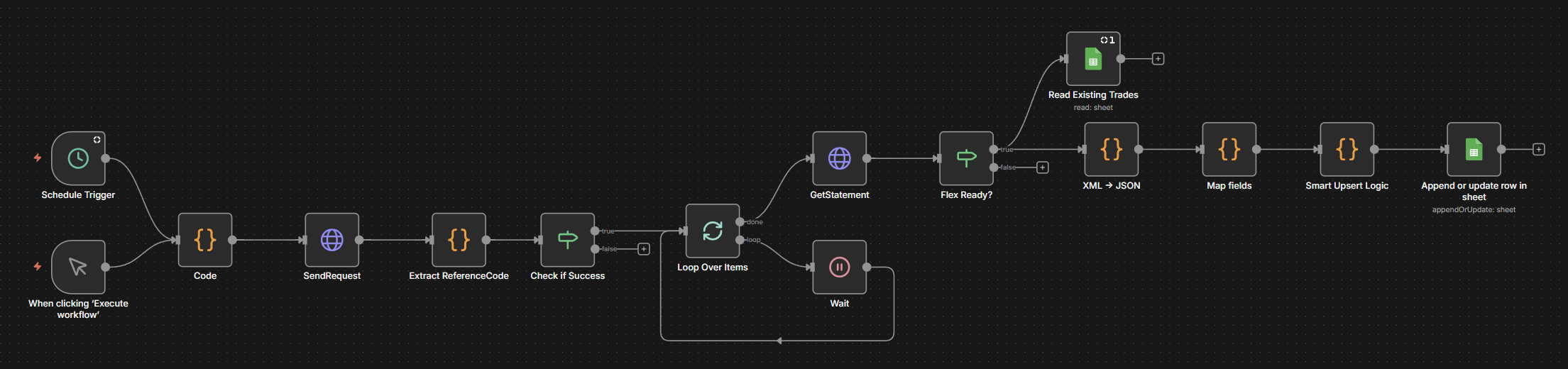
The provider generates reports asynchronously, returning a reference code rather than data, so the flow opens with a batch-and-wait retry loop gated on a status check. No XML parsing node was available, so a recursive parser was written by hand to cope with attribute-only elements, repeated records, and self-closing tags. Fills are classified by instrument type with the order action derived from the open-close indicator, then FIFO lot matching pairs each closing fill against the correct open position. Results and holding periods are computed at match time, including for partial closes.
Workflow Topology
A condensed view of the real node graph.
Outcome & Impact
A trade log that stays current with no manual entry. A scheduled run reduces a batch of raw fills to matched, priced rows in about eighty seconds, work that otherwise means reconciling opens against closes by hand. Because writes are keyed on record ID and the matcher is quantity-aware, the job can be re-run or backfilled safely, and partially closed positions stay accurate between runs.
Challenges & Solutions
- Handling a provider that generates reports asynchronously and returns a reference code instead of data, which required a batch-and-wait retry loop gated on a status check
- Writing a recursive XML-to-JSON parser by hand because no parsing node or library was available in the sandboxed runtime
- Staying idempotent without a database, by treating the output log itself as the state store and re-reading it on every run to deduplicate
- Computing partial-fill accounting correctly, recomputing weighted-average exit and running totals each time another tranche of the same position closes
Key Features
- Automates the two-step report handshake, requesting a statement and polling for its reference code before fetching
- Dependency-free XML parser written by hand, handling attributes, nested elements, self-closing tags, and repeated records
- Normalizes raw fills into a fixed trade schema with instrument classification and derived order actions
- FIFO lot matching pairs each closing fill to the correct open position, including opens arriving in the same batch
- Computes gross and fee-adjusted results, weighted-average exit, and holding period at match time
- Handles partial closes by tracking closed quantity against original size, stamping a close date only once fully unwound
- Idempotent upsert keyed on record ID, so re-runs and backfills never duplicate a row
Tech Stack
Automation
- Platform
- n8n
- Workflows
- 2
- Nodes
- 18
- Triggers
- Schedule, Manual